How do you keep a nature notebook you will actually keep up?
Nature notebooks have a habit of dying in February. Here is how to give yours a longer life, with no drawing talent required.
By the editors · · about 4 minutes
Use a pocket-sized book, write the date and place before anything else, and make your entries short enough that you can stand to do them every time you go out. That is the answer in one sentence. We suspect the usual reason a notebook gets abandoned is a standard set too high, often on a beautiful first page its keeper could not bear to follow.
Step one: buy less than you want to
You do not need special training or expensive kit, as The Wildlife Trusts’ guide says. It suggests a fine liner, pencils of different hardness, an eraser, a sharpener and a small sketchbook, and it recommends a compact book because you will actually carry it. We would go further and start with one pencil. A pencil works in drizzle, and ink often does not.
Avoid anything so handsome it frightens you. A cheap notebook gives you permission to be bad at this for a while. If a book fills up, you can always treat yourself to a nicer one once the habit exists.
Step two: make every entry start the same way
The Natural History Museum gives the four things that turn a note into a useful record: what was observed, where, when, and who made the observation. The Wildlife Trusts add time, weather and behaviour as things worth noting. Put the fixed items at the top of the page and they become automatic. Here is the sort of page we mean, with an invented example.
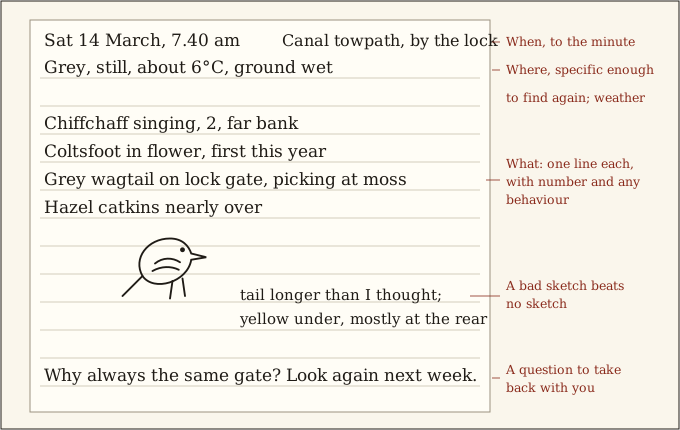
Do not skip the place, or leave it as ‘the usual spot’. In ten years you will not remember, and if you ever want to share your records you will need something specific. A grid reference or a named footpath is best.
Step three: decide what kind of notebook this is
People tend to fall into one of three habits, and all of them are respectable. It saves a lot of guilt to admit early which one is yours.
- The list
- Species and dates, not much else. The museum’s own suggestions include the birds you see and hear in your garden, or the species on a favourite walk. It is quick, and it builds into something surprisingly valuable.
- The sketchbook
- Drawing makes you look. The Wildlife Trusts’ advice is to draw from life and to accept that a sketch of a moving bird will be unfinished, or just to draw one wing or a single leaf. Sketch little and often, and let the failures stand.
- The diary
- Whole sentences, your mood, what the light did. The Natural History Museum is happy with this too, and with stuck-in photos and pressed flowers. This is the one closest to the books we write about on this site.
You can mix them, of course. A mixed book is what most of them become.
Step four: choose a patch and go back to it
This is the most important step here, and it has nothing to do with stationery. Pick somewhere you pass anyway: a stretch of canal, a churchyard, one tree on your way to work. Returning is what makes a notebook interesting, since you begin to see change rather than just a series of things.
It is also the oldest advice in the tradition. Gilbert White built a lasting book out of one parish, and his recommendation that every province should have its own observer still reads well. Once you have a patch, the dates of first flowering and first leaf start to mean something, which leads naturally to recording the signs of the seasons.
Step five: write up afterwards if that suits you better
You are allowed to do this at the kitchen table. Standing in a wet field writing paragraphs is not for everyone, and some good writers did not do it. There is no evidence that J. A. Baker took notes in the field for the diaries behind The Peregrine; he seems to have written up what he had seen on returning home. A few words on the spot and a fuller version that evening is a sound system, as long as the evening version happens that evening. Memory rearranges things quickly.
Roger Deakin’s archive at the University of East Anglia includes more than 100 personal notebooks, which is a comforting number. It suggests that even a writer of his gifts needed to keep filling paper, and it is something to bear in mind on the days your entry reads ‘rain, one crow’.
Step six: decide whether your records should go further
A notebook can stay entirely private. But if you have what, where, when and who, you hold something scientists can use. The museum makes the point that amateurs supply most of the country’s wildlife records, and that a common species is still worth reporting. The NBN Atlas, the UK’s biodiversity data infrastructure, says it now holds more than 387 million species occurrence records.
Two routes are easy to start with. iRecord is a tool for sharing UK wildlife records of many kinds, and BirdTrack, run by the BTO with partners including the RSPB, stores your bird records and uses them for conservation. BirdTrack asks that you are confident of your identifications, and there is no minimum time commitment. If you are unsure of a bird, write down what you saw and what you think, and leave it out of the submission.
When it lapses
It will lapse. Skip the apology on the next page and write the date. A gap is information too: it tells you that was the month the baby arrived or the car broke down, and you will be glad of that in the end. If you need a push to get going again, read something by someone who looked hard. Nan Shepherd is short enough for the purpose.